The jcshepard.com blog took a break this year as we worked out some technical details… and worked through the COVID-19 pandemic. We moved to New Mexico the first of the year, then went to work from home in March. August was a tough month personally with my mom passing on and with the site servers far far away. We saved the site (ahem, my beautiful web maven saved the site), but the page redirects are a work in progress! Who would have thought working from home would be so difficult, but the bandwidth gods frowned on my hopes and dreams for broadband at home.
Our top post this year is six years and three moves behind us now: Cheyenne-Laramie County, Wyoming, Historical Timeline. They cancelled Cheyenne Frontier Days this year. More important to our family, my daughter moved back to Cheyenne this year, had to postpone her wedding in Cheyenne, then moved back out of Cheyenne. Perhaps I will be back in Cheyenne in the coming year. We’ll see.
The most popular new post for 2020 was Absaroka County, New Mexico, posted from beautiful downtown Las Vegas, New Mexico, reporting on Sheriff Walt Longmire’s now shuttered office as the first round of pandemic shutdowns were (briefly) lifting.
Moving the site in August most likely skewed the stats, but WordPress tells me we had 1,266 views from 952 visitors this year. We always get more traffic when we can post more content (makes sense!), so we’ll see what the new year brings.
Americana Music 2020
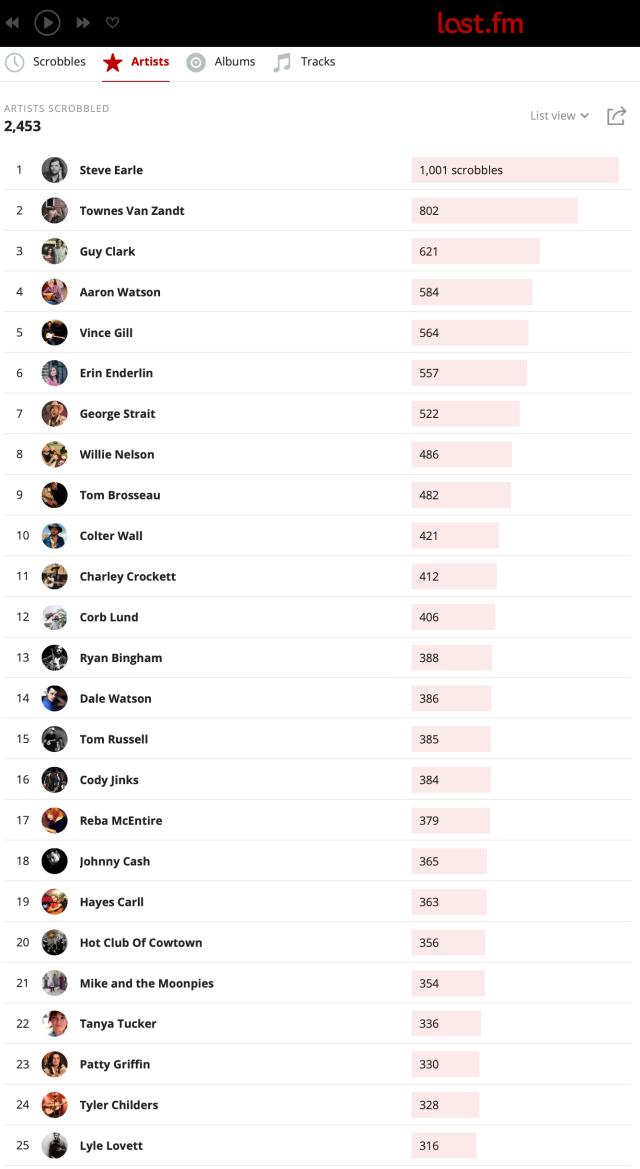
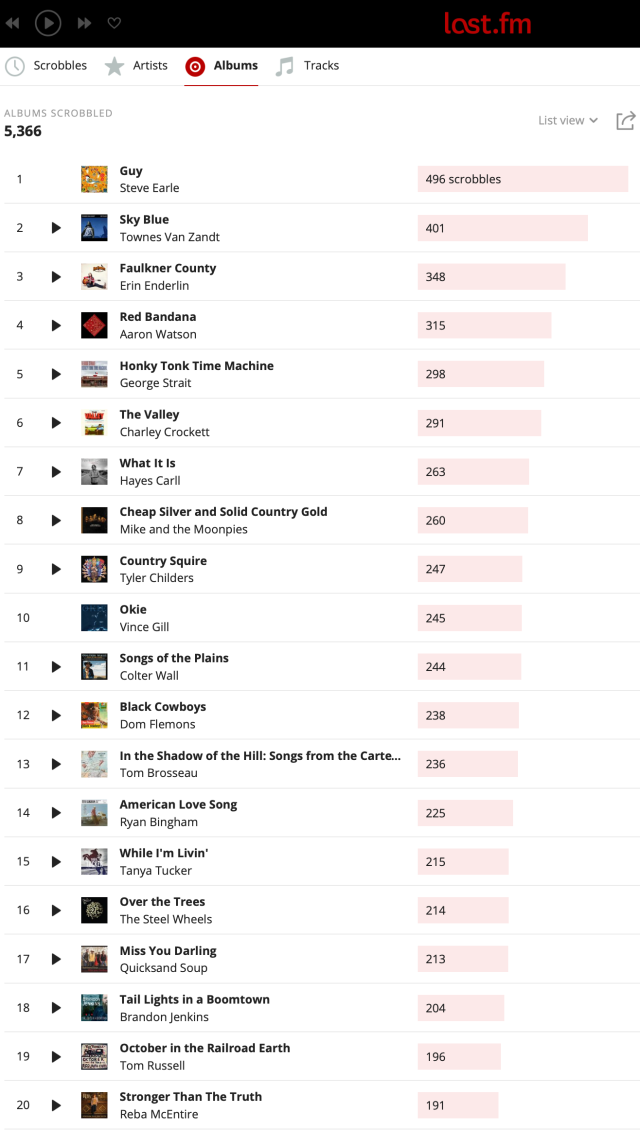
On the music side, I scrobbled more music in 2020 than any other year. Work from Home does that to a guy. I didn’t play so much of the Americana Music Association radio-play and awards nominations as usual. More Real Country music comfort food for the ears.
Corb Lund was the only show I saw during the year, and he got the most play and the top played track, “Old Men”. Erin Enderlin’s album Faulkner County earned the most plays, mostly because I bought that 4 months before Corb’s Agricultural Tragic (and that didn’t show up on Spotify until 3 months after that). I played a lot of Steve Earle, too.
RIP to the many great artists we lost in 2020. Kenny Rogers, Charley Pride, John Prine, and so many more.
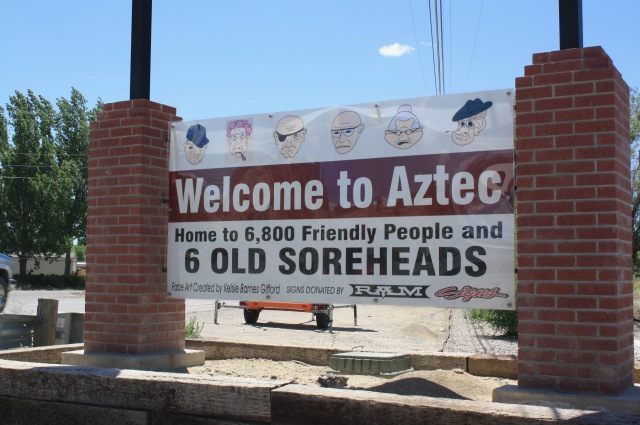
The City of Aztec and Consensus Planning are hosting an online Public Meeting this evening, July 30, 2020, for the Aztec Comprehensive Plan Update project.
I worked in Aztec, New Mexico, on a temporary basis before I moved up to Pagosa Springs a few years ago. I worked on some Downtown Main Street projects and helped review some new development projects. They have some great outdoor recreation. Wish I had more time for hiking and biking. The blue ribbon fishing on the San Juan Quality Waters is world-class. Working in Aztec and the Four Corners region again feels like coming home.
Willow Springs stage station once provided respite at the southern base of Raton Pass for travelers on the Santa Fe Trail’s mountain cutoff. In 1879, the Atchison, Topeka and Santa Fe Railway set rails over the pass from Colorado and their division point became the City of Raton, New Mexico. Later, Interstate 25 connected Denver and Albuquerque–I’ve stopped many times with the kids at the McDonalds in Raton, about half way between the two cities.
One of my first projects at my new job has been helping the City update their Comprehensive Plan. The photo above is a perspective of the city from Goat Hill, looking east across downtown and the old rail yards towards the High Plains. It’s worth getting of I-25 and checking out Main Street.
BSA’s Philmont Scout Ranch is a few miles southwest of Raton, and many Scout Troops arrive & depart by Amtrak at the Raton Station (when the NM Governor lets the camp operate). There is great hiking, camping and boating nearby, at Sugarite Canyon State Park to the east and up in the Sangre de Cristo mountains to the west. Fishers Peak just across the state line is becoming Colorado’s newest state park as well.
In 2004, author Craig Johnson created Sheriff Walt Longmire as the protagonist in his series of Western-crime novels set in fictional Durant, Wyoming, county seat of the equally fictional Absaroka County. Longmire is a crime fighter, but first and foremost his is a gentleman and a cowboy. Johnson has to date gifted us 21 books in the Walt Longmire Mysteries.
In 2012, the A&E network (I’m old enough to remember when it was Arts & Entertainment) brought us a Neo-Western crime drama called “Longmire“, which switched over to Netflix from 2105-2017. Australian actor Robert Taylor plays the good Sheriff Longmire in the series.
Author Johnson lives in Wyoming, and does a good job creating a geography of mind around the real live places around the Big Horn Mountains. Buffalo, Wyoming, claims Longmire Days for their festival (most years but 2020) but Durant shares many aspects of Sheridan, Wyoming, as well. I myself am more of a fan of Wyomingite C.J. Box‘s Joe Pickett Western-crime series, also set below the Big Horns along I-25, but he hasn’t found his A&E or Netflix yet.
As in so many cases, A&E found Longmire, but they took great liberties in adapting the crime stories for their crime drama. That usually ticks me off, but Johnson’s short-story format works better for that than Box’s continuity of series (maybe why Box isn’t on screen yet). Anyway. A&E changed the narrative, and they moved Abasoroka County 750 miles sound down the Interstate to Las Vegas, New Mexico.
New Mexico has a burgeoning film industry, with studios that can fit tv and movie sets and the support systems they need. I don’t like when Hollywood thinks they are smarter than authors, but they also like working in a warmer climate. I get that. And I admit I really like how they make Las Vegas, Santa Fe, and the Sangre de Cristos stand in for the Big Horns (though you will be unlikely to find piñon pines in the northern Rockies).
This Las Vegas, population 13,100, was settled in 1835 as part of a Mexican land grant, and became a bustling stop on the Santa Fe Trail. The Plaza was laid out in the traditional Spanish colonial style, as a central square with adobe buildings that could double as fortifications, so they were built tightly with narrow streets. The Plaza Hotel was built on the north side of Plaza Street in 1880, just after the Atchison, Topeka, and Santa Fe (ATSF) Railway arrived a mile to the east, prompting development of an entire New Town around the depot.
In 1895, the Veeder Brothers built a two-story brick building just west of the Plaza across Pacific Street. Fast forward to the second decade of the 21st century. With protection as contributing resources of the Las Vegas Plaza Historic District, the Veeder Block with the revived Plaza Hotel next door made the perfect exterior location for the Absaroka County Sheriff’s Department.
Las Vegas, New Mexico, has had its challenges, even before the 2020 COVID-19 lockdowns. Even now as many businesses open in late May, the Governor of New Mexico is not inviting tourists back yet. We were not exactly welcome in Las Vegas over Memorial Day weekend, but it was a beautiful day for a drive anyway. Hopefully somebody will be open to take our money and sell us a Green Chile Cheeseburger next time we head up that way–you won’t find Green Chile in Wyoming either, so Absaroka County, New Mexico does have that going for it.
Corb Lund put on an amazing show on Central Avenue–Old Route 66–in Albuquerque, New Mexico, on Sunday March 8th, 2020, just before we all went into nation-wide lockdown. Corb has a new album coming out, Agricultural Tragic, and I scored a pre-release copy at the show. Yeah band merch.
Too many “country” artists are all hat and no cattle. Corb was wearing his hat, and he had cattle back at the ranch in Alberta, just north of where my wife grew up in Montana. His album Things That Can’t Be Undone has become just about my favorite album, ever. Or at least most played since it came out in 2015. His 2012 album Cabin Fever is pretty timely for the coming COVID chaos, too.
Local music fan Matt Nida recorded the show right next to us, up in the balcony, and loaded Corb Lund’s 3/8/2020 show on the Internet Archive. So now I can relive the show and you can stream it, since who knows when we’ll be able to see a live show next.
Dale Watson doesn’t much care for the “Americana” appellation, so he went and dubbed himself “Ameripolitan”. That’s a nod to the old “Countrypolitan” style of Chet Atkins’ 1960s’ Nashville Sound. Now I’m not much of a Chet Atkins fan of orchestrated pop country, but it’s still better than anything in 21st Century pop country. Dale Watson takes his influence from the pioneering artists (e.g. Jimmie Rodgers, Bob Wills, Lefty Frizzel, Ray Price. etc.) and creates music that’s much better than most anything now and then.
“Quit complaining, and do something about it.” -Dale Watson
So the last few year’s Dale’s been throwing a soiree for the Ameripolitan Awards in Memphis, Tennessee, and this year’s show was last weekend. The winners are (as reported by the most excellent Saving Country Music site):
Charley Crockett – Honky Tonk Male
Sarah Vista – Honky Tonk Female
The Country Side of Harmonica Sam – Honky Tonk Group
Bloodshot Bill – Rockabilly Male
Laura Palmer – Rockabilly Female
Mark Gamsjager and the Lustre Kings – Rockabilly Group
Dave Stuckey – Western Swing Male
Georgia Parker – Western Swing Female
The Farmer and Adele – Western Swing Group
Full disclosure–Charley Crockett is the only one of these artists I’ve listened too, but Charley Crockett is AWESOME. Plus the playbill rocked, with Junior Junior Brown, The Reverend Horton Heat, Big Sandy and His Fly-Rite Boys (on their way to Albuquerque next week), Wayne “The Train” Hancock, and a surprise appearance from Grammy winner Tanya Tucker.
Speaking of the Grammys, they didn’t suck this year. Well, those artists nominated and awarded mostly didn’t suck. I don’t know about the show, because I didn’t watch it. Highlights would be:
Tanya Tucker won Best Country Song for “Bring My Flowers Now” and Best Country Album for While I’m Livin’ .
Willie Nelson won Best Country Solo Performance for “Ride Me Back Home” (name recognition, but yeah, go Willie).
Less I say about Dan & Shay (Best Country Duo/Group) the better for my “didn’t suck” theme here.
Rhiannon Giddens and I’m With Her got robbed in Best American Roots Performance, but I’ve streamed winner Sara Bareilles a few time since and she doesn’t suck.
The ladies of I’m With Her did win Best American Roots Song for “Call My Name” so go Sarah, Aoife & Sara.
Keb’ Mo’ won Best Americana Album for Oklahoma.
Michael Cleveland won Best Bluegrass Album for Tall Fiddler.
Delbert McClinton won Best Traditional Blues Album for Tall, Dark & Handsome, which is a fun album.
Gary Clark, Jr. won Best Contemporary Blues Album for This Land.
Patty Griffin brought home Best Folk Album for her self-titled release Patty Griffin, as it should have.
And Lil’ Nas X (not a Country artist) didn’t win Best New Artist, and it’s OK that he & Billy Ray (no longer a Country artist) got Best POP DUO because they are, exactly that, POP stars not COUNTRY.
It’s the end of the decade… or maybe that’s the end of 2020 instead of the beginning. Either way, jcshepard.com is 10-years old, a decade since we went online 1 January 2009. Happy birthday to the blog. In 2018, our site here had 1,400 visitors give about 6,200 views, with August 2018 garnering more clicks than any other month. In 2019, traffic pulled back, with 1,300 visitors and almost 1,900 views.
It is what it is. I just post about what I’m reading and what I’m listening to. Thank you for visiting.
#1 post of 2019: Cheyenne-Laramie County, Wyoming, Historical Timeline. Repeat winner by far, Cheyenne-Laramie County, Wyoming, Historical Timeline: a 2014 keyword-rich retrospective of the capital of the Cowboy State, which celebrated their 150th Anniversary in 2017.
#2: Be Here to Love Me…for free. Yeah, the “free” part is gone since this 2011 post posted, and it feels kinda click-baity, but it is what it is. ICYMI, listen to Townes Van Zandt’s new release, Sky Blue. You can stream Spotify that for “free”, too.
#8 overall & #1 NEW POST OF 2019: The Martyr Richard Woodman. The story of Richard Woodman reminds us that once upon a time, Western peoples were willing to die for their religious beliefs. 1557 wasn’t really that long ago.
#9: All Thing Shepard. History meets genealogy. Down a spot again. Dramatically due for an update. Rootsweb got hacked late 2016, though, and Ancestry had it down for a good while. The site’s back up but re-arranged and due for some attention.
#10: The Day the Music Died. Tribute from 10 years ago for the late, great Buddy Holly and company,
Most of you are viewing the blog from the gold old U.S. of A. My next largest number of views this year and last are coming from Red China and South Korea. Interesting. It is what it is. Thank you for visiting in 2020.
The Year in Music for 2019 was dedicated to Guy Clark and Susanna Clark, with a coda for the late, great Townes Van Zandt.
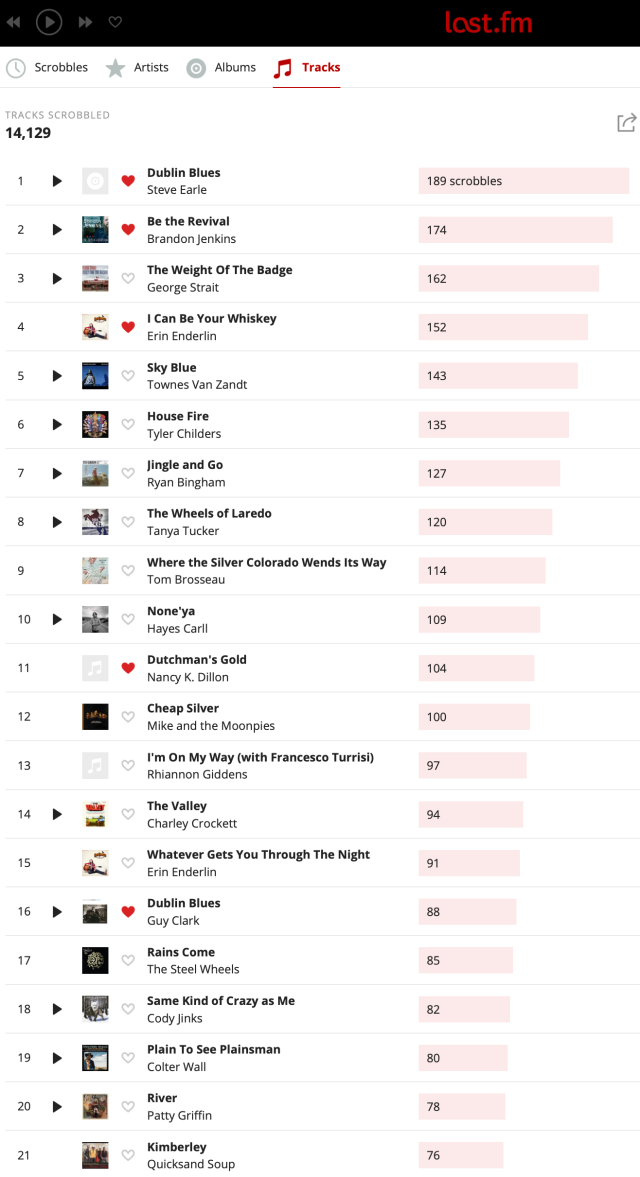
As soon as I heard about Steve Earle’s project to dedicate an album of covers to Guy Clark’s memory, I knew this would be my favorite recording of 2019. GUY held up to my expectations, even better than Earle’s tribute TOWNES did 10 years earlier. As Earle previously made “Pancho and Lefty” his own, this time around he bought and paid for “Dublin Blues”, a song I never really realized how good it is lyrics and music both.
Other artists paid tribute as well. Vince Gill sang “Nothin’ Like A Guy Clark Song” on his Grammy-nominated albumOkie. Aaron Watson opened Red Bandana with “Ghost of Guy Clark”, in which the spirit of the great songwriter tells our hero his song’s OK “if that’s all you’ve got to give”. And while George Strait finally got to “Sing One with Willie”, Willie Nelson covered Clark’s “My Favorite Picture of You” (a tribute to Guy’s wife, Susanna, which damn well better bring tears to your eyes no matter who sings it).
We also heard the ghost of Townes from beyond the beyond, with the posthumous Sky Blue. As related by NPR, this the songwriter recorded these tracks in a visit to his friend Bill Hedgepeth in Atlanta, Georgia, in 1973. The session included to previously unreleased songs, “All I Need”, and the title track “Sky Blue”, which I played into the ground. This take on “Pancho and Lefty” is pretty good, too, but the “Snake Song” and “Dream Spider” give me the heeby-jeebies.
Erin Enderlin, an Arkansas country musician and songwriter, is my surprise discovery of 2019. After teasing EPs all year, released in four story-cycles, her album Faulkner County would have been my favorite release of the year, in any other year. “Tonight I Don’t Give a Damn”, “I Can Be Your Whiskey”, “Whatever Gets You Through the Night”–doesn’t get much more Country than that. Kudos to Corey Parkman “Farce the Music” for including Enderlin in his periodic Spotify playlist, for this find.
George Strait delivered another George Strait album just a bit better than most of pop country radio deserves, but he really hit a tear-jerker with “The Weight Of The Badge”. If you’re wondering why Red State America isn’t responding to Liberal Social Justice Warriors (and despite my antipathy for Trumpist fear-mongering), just listen to this song. We are the Law. We are the Rule of Law. We are One with Law Enforcement, and we cannot pay the Boys in Blue enough for the weight they carry each and every day.
Among the other songs in my Top 10 and Top 20, some are getting their share of Real Country love and attention, and others ought to. Tyler Childers is up for a Grammy (huh? what? yeah, go figure.). So are Tanya Tucker and Willie Nelson. I shoulda listened to Ashley McBryde more, she’s on the Grammy list, too. Rhiannon Giddens is just, wow. Then fast-forward to the Grammy Folk category and Patty Griffin is, well, Patty.
There’s a bunch of great music released in 2019, and some of the tunes from 2018 rolled over into my heavy Scrobble rotation again this year. We lost the Red Dirt Legend, Brandon Jenkins, in March 2018, and “Be the Revival” off his last album was my Top Tune of 2018 and still gets to me in 2019. And along with Colter Wall’s “Plain to See Plainsman”, folk artist Nancy K. Dillon’s “Dutchman’s Gold” got to the cowboy in me. Also in my Top 50 was Dom Flemons’ “Steel Pony Blues” off Black Cowboys. (Dom is in Carolina Chocolate Drops with Rhianon Giddens.). Charley Crockett’s The Valley fits in here, and you might notice, too, my Top 21 tracks extended to include “Kimberly” by Quicksand Soup, Sand Sheff’s new band up Moab way.
Despite what I said above about George Strait fans, the cowboy way isn’t political, it isn’t an ethnicity or a voting bloc or guys who like big hats. A cowboy’s life is a road less traveled, and it deserves all the ink it gets, and that sounds like a good goal for me to ponder on in 2020.




 STrib
STrib The Economist