

Diary of Orrin Brown, Goldsboro, North Carolina
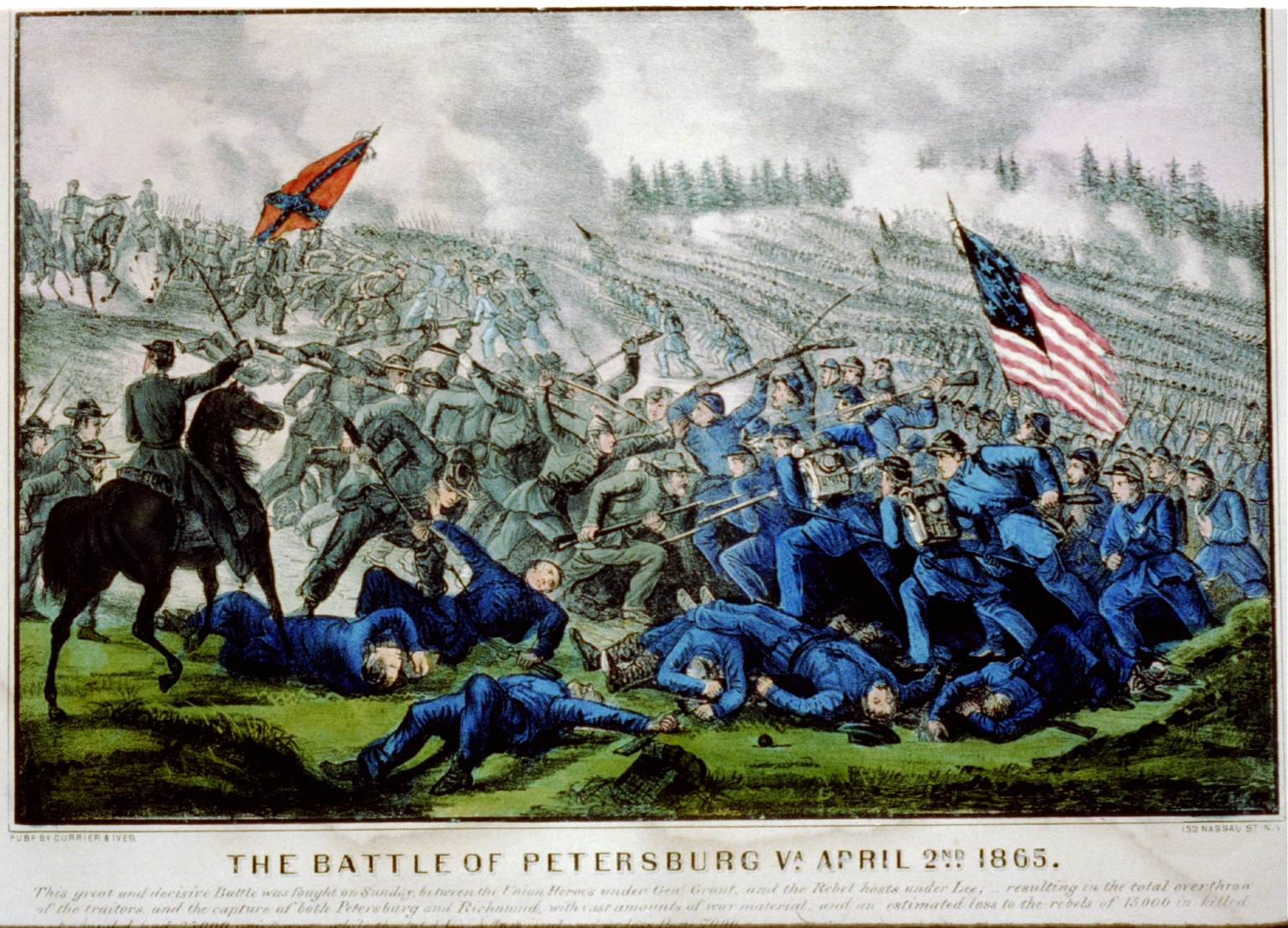
Sunday–Apr. 2nd
We have had another very nice day. We had General Inspection at 9 AM and dress parade at 5 PM. I reced. a letter from home today. Loren Moulton came over today and we had another good visit. My health is better now than it has been in two months. I wrote a good long letter to Lorens folks today. I read 2 Chapt. in Testament.
Breakthrough at Petersburg
While Sheridan and Warren attacked the Confederate far right lines at Five Forks on the 1st, Union Maj. Gen. John G. Parke and the IX Corps assaulted Fort Mahone east of Petersburg.
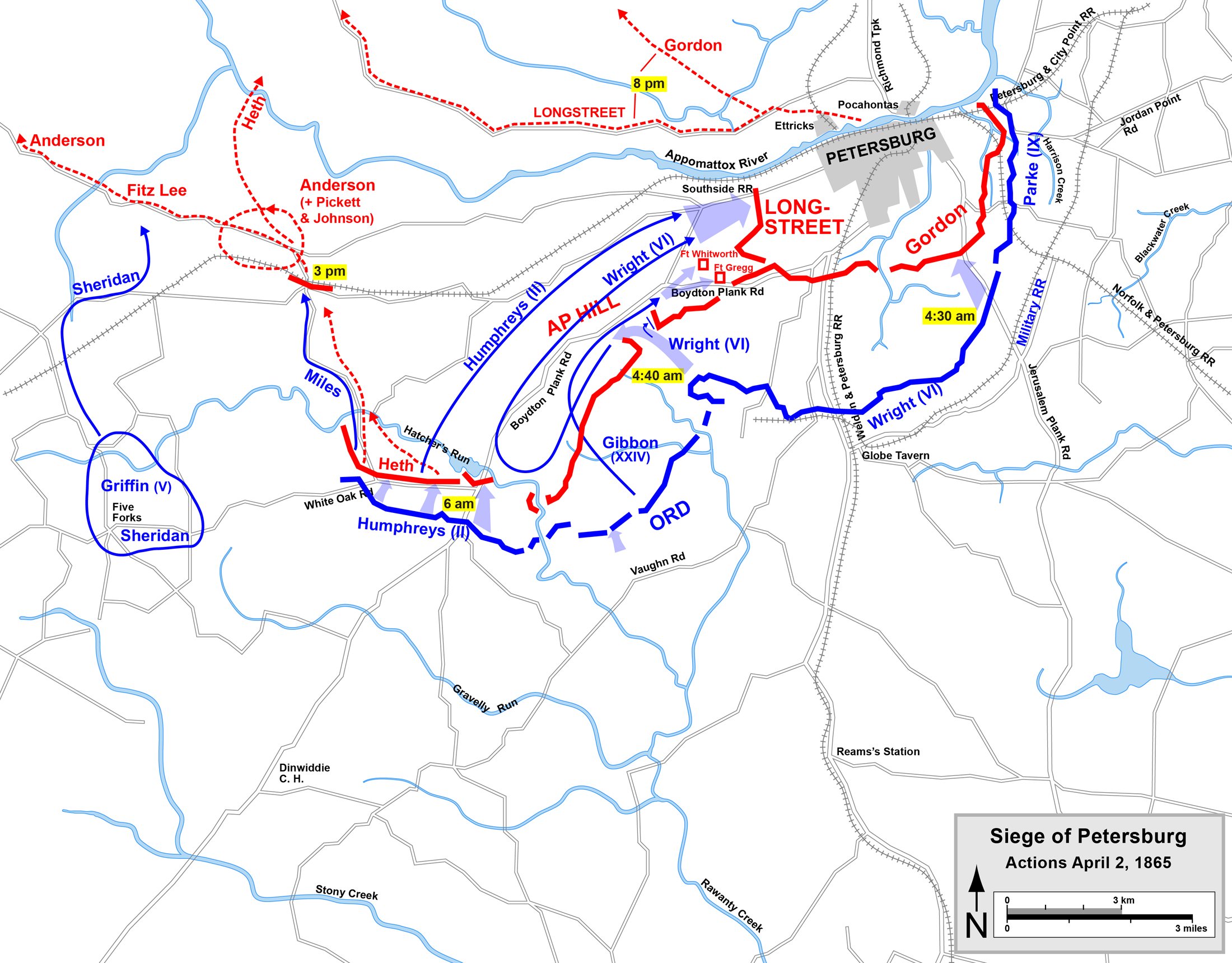
At 4:40 am on the 2nd of April, Union Maj. Gen. Horatio G. Wright led the VI Corps against the Boydton Plank Rod held by Confederate Lt. Gen. Ambrose Powell “A.P.” Hill. The Vermont Brigade led the corp in a large wedge formation. The Rebel lines broke in 20 minutes, and Wright turned the VI Corps south to clear the road as Maj. Gen. John Gibbon and the newly-created XXIV Corps moved into the breech before being becoming bogged down at Confederate Ft. Gregg through the afternoon. Hill was shot from his saddle as he tried to rally his troops. Fort A.P. Hill, long-time site of the Boy Scouts of America’s National Jamboree, is named in memory of Lt. Gen. A.P. Hill.
On the Union left, Maj. Gen. Andrew Humphreys‘ II Corps faced Confederate Maj. Gen. Henry Heath, strung out from Hatcher’s Run to White Oak Road. Heath began to fall back after the Union breakthrough, and Humphreys followed until ordered to turn on Petersburg proper. Maj. Gen. Nelson Miles’ division stayed back and attacked Heth at Sutherland’s Station, capturing about 1,000 Southern troops as the rest of the column retreated west. In fact, using strategic delaying actions, Lee was able to evacuate the majority of his army from Petersburg before the city fell that night. Overall, Union forces suffered approximately 3,500 casualties, to 4,250 for the Confederates.
After the VI Corps break-through, Gen. Lee advised the Confederate government to abandon the capital at Richmond and retreat to the west, which they did that evening. The plan was to fall back to Amelia Court House and regroup at Danville, or Lynchburg, Virginia, where supplies had been evacuated.
Read More:
- Guide to the Richmond-Petersburg Campaign (U.S. Army War College Guides to Civil War Battles) edited by Charles R. Bowery, Jr, and Ethan S. Rafuse (University Press of Kansas, 2014)
- The Richmond-Petersburg Campaign, 1864–65 (Battles and Leaders of the American Civil War) by Charles R. Bowery Jr (Praeger, 2014)
- Richmond Must Fall: The Richmond-Petersburg Campaign, October 1864 (Civil War Soldiers and Strategies) by Hampton Newsome (Kent State University Press, 2013)
- Crucible of Command: Ulysses S. Grant and Robert E. Lee–The War They Fought, the Peace They Forged by William C. Davis (Da Capo Press, 2015)
- Grant and Lee: Victorious American and Vanquished Virginian by Edward H. Bonekemper III (Prager, 2007)
- Grant and Lee. The Virginia campaigns 1864-1865 by William A. Frassanito (Charles Scribner’s Sons, 1983)
- Sherman’s March Through the Carolinas by John Gilchrist Barrett (Univ North Carolina Press, 1956)
- Fierce Patriot: The Tangled Lives of William Tecumseh Sherman by Robert L. O’Connell (Random House, 2014)
- The March to the Sea and Beyond: Sherman’s Troops in the Savannah and Carolinas Campaigns by Joseph T. Glatthaar (New York University Press, 1985)
- The Memoirs Of General William T. Sherman by W.T. Sherman (Library of America, 1990)
(As an Amazon Associate, we may earn commissions from qualifying purchases. Check your local library or bookshop, too.)
.



1 Comment